
The central question
When geometry meets interactions.
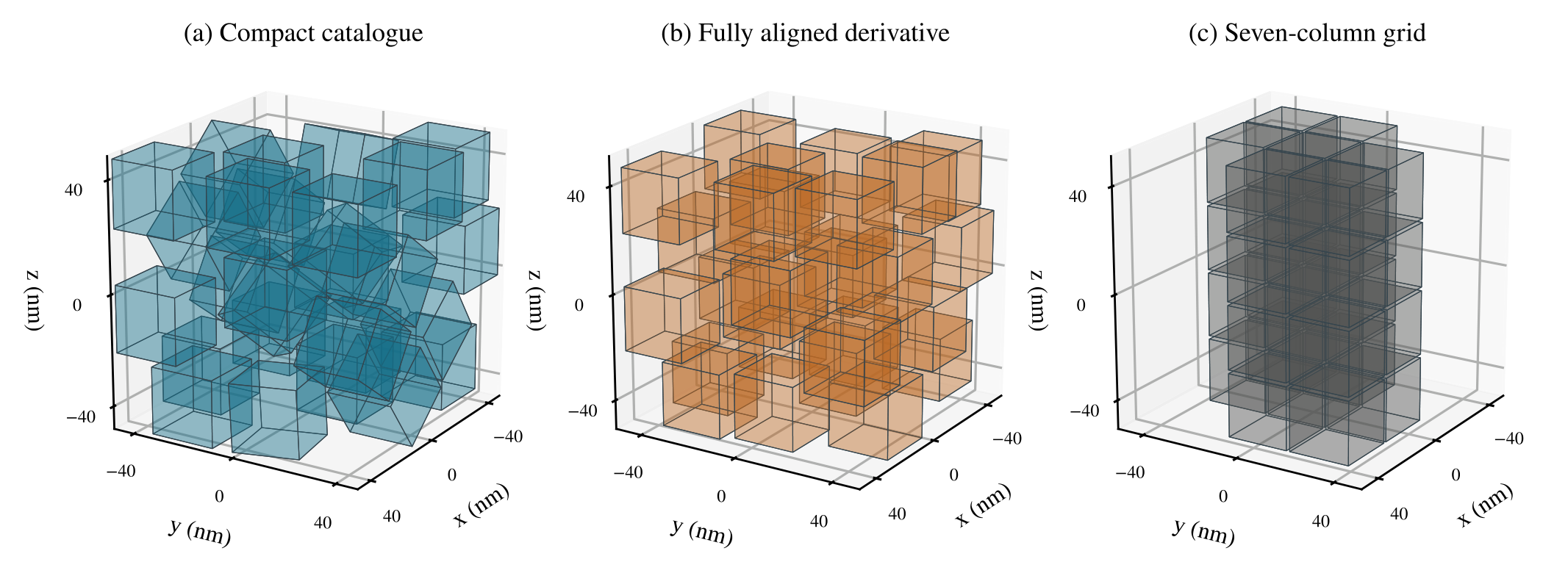
A packing catalogue tells us how objects fit into a space. It does not, by itself, tell us how a material will behave. This study asks what survives the transfer from a certified arrangement of cubes to an idealized magnetic system, where the response also depends on the interactions among those cubes.
The comparisons use 28 magnetite-like cubes in a finite equilibrium macrospin model. Geometric certification, numerical validation, and physical modelling are kept distinct, so readers can see which claims each layer supports.
Three comparisons worth examining
Architecture changes the response
The fully aligned catalogue derivative exceeds the tested directional grid in cavity-normalized response, with cube count, body frames and cavity size matched. Approximate 95% Monte Carlo interval: 60.64% to 61.25%.
Orientation matters too
At identical centres and density, source rotations outperform half alignment. This changes both finite-body interactions and registered crystal anisotropy. Interval: 8.31% to 8.73%.
Density is not the whole story
Compressing the source increases loading but reduces cavity-normalized response at the nominal operating point. Interval: −3.56% to −2.13%. A lower-moment case reverses the sign.
All three comparisons are at 298 K and 10 mT under the nominal model. These intervals describe Monte Carlo uncertainty; they do not include physical-model uncertainty.
What the result establishes
The contribution is a traceable computational benchmark with controlled comparisons and a reproducible audit. In the aligned-versus-grid comparison, the interaction term is the only changed Hamiltonian term; the analysis does not establish a unique geometric mechanism.
The work does not claim an experimentally demonstrated device gain, a globally optimal architecture, or a certified continuum material response. The older compression estimate of −4.005593% remains unresolved; version 1.1 explicitly distinguishes it from the fresh estimate and reports that the examined quadrature correction cannot account for the gap.
Read the paper. Follow the evidence.
- Accepted manuscript · v1.1 (PDF) ↓
- Revision audit package · v1.1 (ZIP, 32 KB) ↓
- Original data, code and proof supplement · v1.0 · DOI 10.5281/zenodo.23629684 ↗
The DOI identifies the original v1.0 supplement. It is not a DOI for the accepted v1.1 manuscript. The revision audit adds analyses of retained trajectories; no new Monte Carlo runs were introduced in the revision.
Publication and review record
Version 1.1 was accepted and published in JOATP on 27 October 2026 following revision and final editorial verification. The author-supplied PDF is reproduced unchanged and retains its manuscript/preprint formatting. The original data and headline estimates are unchanged. The v1.1 audit adds analyses of retained trajectories; the historical compression discrepancy remains explicitly unresolved.
Review basis: AI-assisted editorial assessment and final verification, with the publication decision made by Todd J. Desiato. No independent external referee review is claimed.
Funding and interests: The author reports personal funding without external grant or client support and discloses cofounding Superradiant, whose commercial verification and materials interests overlap the study.
© 2026 Alejandro Zarzuelo Urdiales. The manuscript, author-created figures, tables and study data are available under Creative Commons Attribution 4.0. Software and third-party components retain their accompanying license notices.